Claim Your Free Estimate Today
Table of Contents
- How to Choose the Best Water Filtration System for Your Home
- Quick Comparison: Top Water Filtration Systems for Homes
- Best Water Filter for Well Water
- Whole-House vs. Under-Sink Water Filter: Which Fits Your Home?
- NSF/ANSI Certified Water Filters: What the Seals Actually Mean
- Home Water Filter Replacement Schedule and Total Cost of Ownership
- Installation, Water Waste, and What Competitors Skip
- Conclusion: Match the System to Your Water, Not the Hype
- Frequently Asked Questions
Last Updated: October 14, 2026
How to Choose the Best Water Filtration System for Your Home
The best water filtration systems for homes are not the ones with the longest feature list. At Acclaimed Drain And Plumbing Solutions, LLC, we install and service water treatment and filtration systems across Tucson and Southern Arizona, and the pattern we see is consistent: homeowners buy a filter, then discover it does not target their problem.
Start With a Water Test, Not a Product Page
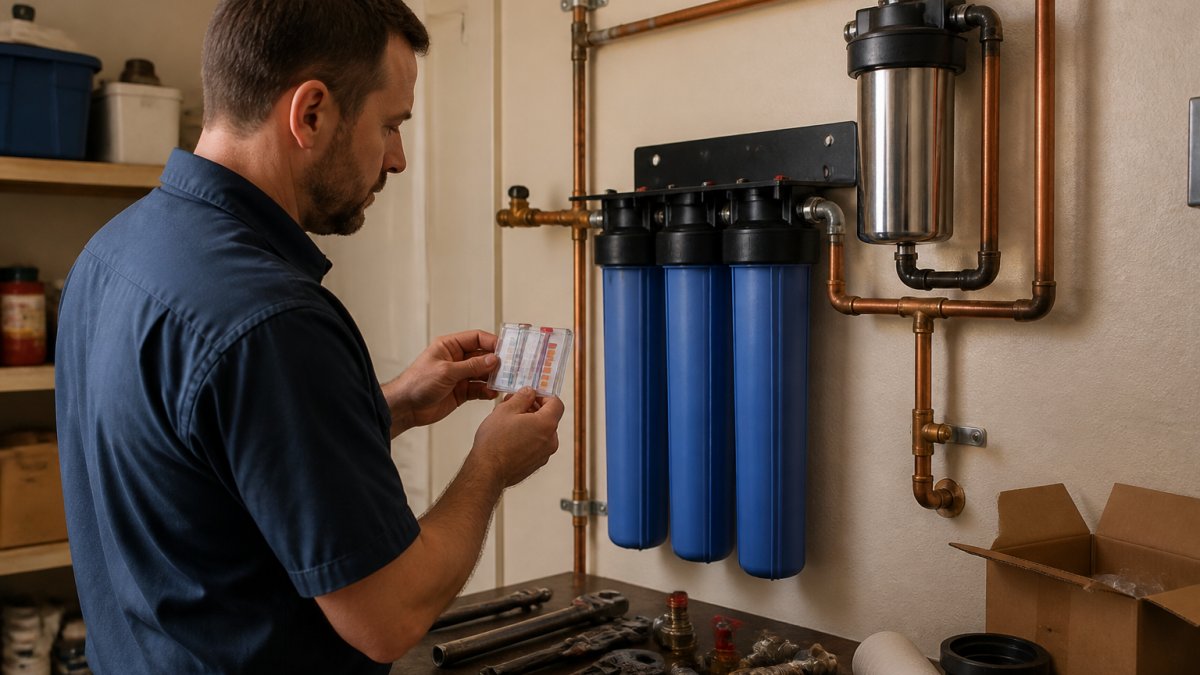
A water test tells you which contaminants are present before you spend anything. Municipal suppliers publish annual water quality reports, and the EPA’s guidance on drinking water quality reports explains what those documents cover. Private well owners get no such report, so testing is the only way to know what you are treating. Test first, then shop. Every recommendation below assumes you have that baseline.
Pro Tip
Test at the tap, not just at the meter. Sediment and scale can build up inside older interior plumbing, so the water entering your home and the water leaving your kitchen faucet are not always the same quality.
Test at the tap, not just at the meter. Sediment and scale can build up inside older interior plumbing, so the water entering your home and the water leaving your kitchen faucet are not always the same quality.
Quick Comparison: Top Water Filtration Systems for Homes
Here is how the leading options stack up by type, target contaminants, certification to look for, and best use case. Treat this as a shortlist, not a verdict, the right pick depends on your water test and your plumbing.
| System Type | Best For | Typical Contaminants Targeted | Certification to Verify | Maintenance Level |
|---|---|---|---|---|
| Whole-house (point-of-entry) | City water, entire home | Chlorine, chloramine, sediment, some VOCs | NSF/ANSI 42 for taste and odor; NSF/ANSI 53 for specific health claims | Moderate |
| Under-sink reverse osmosis | Drinking water only | PFAS, VOCs, dissolved solids, lead, arsenic (model-dependent) | NSF/ANSI 58 for RO; NSF/ANSI 53 or 401 for specific contaminants | Moderate |
| Countertop RO | Renters, small kitchens | PFAS, VOCs, dissolved solids | NSF/ANSI 58 (verify the exact model listing) | Low |
| Pitcher or gravity filter | Budget, basic taste and odor | Chlorine, some metals (model-dependent) | NSF/ANSI 42; NSF/ANSI 53 only if the label says so | Low |
| Well water system | Private wells | Iron, sulfur, sediment, bacteria, hardness | Varies by stage; UV often certified to NSF/ANSI 55 | Higher |
A whole-house filter protects every fixture, while an under-sink unit concentrates performance at one tap. Most homes with a specific drinking water concern pair the two.
What the table does not tell you
Three variables decide whether a system actually works in your home, and none of them fit neatly in a comparison grid:
- Contaminant specificity. A filter certified for chlorine taste and odor is not automatically certified for lead, PFAS, or arsenic. The certification listing names the exact contaminant and the exact model. If your test shows a contaminant the listing does not name, the filter is not verified for it.
- Flow rate and pressure. Whole-house units are rated in gallons per minute (gpm) at a stated pressure drop. A unit rated below your peak household demand, showers, laundry, and irrigation running at once, will starve fixtures. Under-sink RO units typically deliver a slow trickle to a dedicated faucet and rely on a small storage tank, which is fine for drinking water and impractical for filling a bathtub.
- Capacity versus household size. Cartridge and membrane life are rated in gallons treated, not months. A family of five on hard, sediment-heavy water will burn through media far faster than a couple on soft municipal supply, even with the same filter.
Pro Tip
Before you compare two systems on price, write down three numbers: your peak household flow demand in gpm, the gallons your household uses per day, and the specific contaminant your test flagged. Those three numbers eliminate most of the shortlist for you.
Before you compare two systems on price, write down three numbers: your peak household flow demand in gpm, the gallons your household uses per day, and the specific contaminant your test flagged. Those three numbers eliminate most of the shortlist for you.
Matching the system to the problem
- Chlorine taste and odor only, city water: a whole-house carbon filter certified to NSF/ANSI 42 covers showers, laundry, and drinking water at once.
- Lead, PFAS, or arsenic at the tap: an under-sink reverse osmosis or a carbon block certified to NSF/ANSI 53 or 401 for that specific contaminant, installed at the kitchen tap.
- Renter or small kitchen: a countertop RO or a certified pitcher filter, no plumbing modification required.
For pricing on a system installed in your home, request a quote rather than relying on retail listings, since installation requirements vary by plumbing layout.
Best Water Filter for Well Water
The best water filter for well water depends on your test results, because wells vary enormously from property to property. Iron, sulfur odor, sediment, and hardness are the usual culprits, and each needs different media. A sediment pre-filter is almost always the first stage, protecting everything downstream. From there, an oxidizing filter handles iron and sulfur, and a softener addresses hardness.
Watch Out
Never size a well water system without a recent test. Iron levels, pH, and hardness change how media performs, and a system built for the wrong chemistry will clog, channel, or fail early. The consequence is a filter that looks installed but does almost nothing.
Never size a well water system without a recent test. Iron levels, pH, and hardness change how media performs, and a system built for the wrong chemistry will clog, channel, or fail early. The consequence is a filter that looks installed but does almost nothing.
Whole-House vs. Under-Sink Water Filter: Which Fits Your Home?
Whole-house and under-sink filters solve different problems, and choosing between them comes down to scope. A whole-house system treats every drop entering the home, protecting showers, laundry, and appliances from chlorine and sediment. An under-sink system treats one tap, usually the kitchen, and can use tighter media like reverse osmosis membranes that would be impractical to run through an entire house.
Quick Picks:
- Best overall for most city-water homes: a whole-house system, for full coverage
- Best for drinking water only: an under-sink reverse osmosis unit
- Best for renters or small kitchens: a countertop reverse osmosis filter
NSF/ANSI Certified Water Filters: What the Seals Actually Mean
NSF/ANSI certification means an independent lab verified a specific performance claim on a specific model, not that a filter removes everything. The NSF’s explanation of drinking water treatment standards breaks down what each standard covers. The distinction matters because packaging routinely implies broader performance than the certification listing supports.
The standards you will actually see
| Standard | What it covers | What it does not cover |
|---|---|---|
| NSF/ANSI 42 | Aesthetic effects: taste, odor, chlorine, sediment | Health-related contaminants such as lead or PFAS |
| NSF/ANSI 53 | Health-related contaminants: lead, VOCs, cysts, and other named contaminants | Contaminants not named on the listing |
| NSF/ANSI 58 | Reverse osmosis systems | Non-RO systems |
| NSF/ANSI 401 | Emerging contaminants such as PFAS and some pharmaceuticals | Contaminants outside the standard’s scope |
| NSF/ANSI 55 | Ultraviolet microbiological treatment | Chemical contaminants |
A filter certified to Standard 42 alone is not certified for lead removal, no matter how the packaging reads. A filter certified to Standard 53 for lead is not automatically certified for PFAS, those are separate claims on separate listings.
Claim Your Free Estimate Today →
How to verify a claim in about two minutes
- Find the exact model number. Not the brand, not the product family, the model number on the unit or the box.
- Look up the certification listing. Manufacturers publish listings, and certification bodies maintain searchable databases. The listing names the standard, the contaminant, and the reduction percentage the lab verified.
- Match the contaminant to your test result. If your test shows arsenic and the listing names lead and cysts, the filter is not verified for your problem.
- Check the replacement cartridge, not just the housing. Certification applies to the system as tested, including the specific cartridge. A generic replacement cartridge may void the verified claim.
Key Takeaway
Match the standard to your contaminant, then match the listing to your exact model. If your test shows lead, you need a Standard 53 listing that names lead reduction on that specific model, not a general “certified” badge, and not a claim inherited from a different product in the same line.
Match the standard to your contaminant, then match the listing to your exact model. If your test shows lead, you need a Standard 53 listing that names lead reduction on that specific model, not a general “certified” badge, and not a claim inherited from a different product in the same line.
Where marketing language diverges from tested performance
A few patterns are worth recognizing:
- “Removes up to 99%” without naming the contaminant, the test conditions, or the standard. A verified claim names all three.
- “Certified” with no standard number. Certification to Standard 42 for taste and odor is real, but it says nothing about health-related contaminants.
- “Tested to” versus “certified to.” A manufacturer’s internal test is not third-party certification.
Why this matters more for some systems than others
Whole-house and under-sink systems vary widely in what they are actually verified to remove, and the gap between the two is often larger than the price difference. A whole-house carbon filter is typically certified for aesthetic chlorine reduction across the whole home, while an under-sink RO unit is typically certified for a longer list of health-related contaminants at a single tap.
Watch Out
Certification is not a substitute for a water test. A filter can be fully certified for a contaminant you do not have and silent on the one you do. Test first, then verify the listing against your results.
Certification is not a substitute for a water test. A filter can be fully certified for a contaminant you do not have and silent on the one you do. Test first, then verify the listing against your results.
Home Water Filter Replacement Schedule and Total Cost of Ownership
A home water filter replacement schedule is the number most buyers ignore, and it quietly decides the real cost. The purchase price is only the entry fee. Sediment pre-filters typically need changing every few months, carbon blocks roughly every six to twelve months, and reverse osmosis membranes every two to three years, though usage and water quality shift those intervals.
| Component | Typical Replacement Interval | Cost Driver |
|---|---|---|
| Sediment pre-filter | Every few months | Sediment load in supply |
| Carbon block | 6-12 months | Water volume treated |
| RO membrane | 2-3 years | Usage and water quality |
| UV lamp (well systems) | Annually | Runtime hours |
For pricing on a system installed in your home, request a quote rather than relying on retail listings, since installation requirements vary by plumbing layout.
Installation, Water Waste, and What Competitors Skip
Installation and water waste are the two details most product roundups skip, and both shape whether a system is right for you. Whole-house units tie into your main line and need adequate water pressure and a drain path for backwash. Under-sink reverse osmosis needs a dedicated faucet and a drain connection, which older cabinetry may not accommodate. Reverse osmosis also produces wastewater as part of the process, so efficiency varies by model and matters more in drought-prone regions.
Best For
Homeowners who want the system sized, installed, and maintained correctly the first time, rather than buying a box and troubleshooting it alone.
Homeowners who want the system sized, installed, and maintained correctly the first time, rather than buying a box and troubleshooting it alone.
Conclusion: Match the System to Your Water, Not the Hype
The right system is the one built around your test results, your plumbing, and your long-term budget, not the one with the loudest marketing. Acclaimed Drain And Plumbing Solutions, LLC provides free estimates, financing options for eligible projects, and a maintenance membership program that keeps filters and media on schedule so performance does not fade. We handle water treatment and filtration installation alongside the plumbing work it depends on.
Frequently Asked Questions
What is the best home water filtration system for well water?
Well water needs different treatment than municipal water because it often contains sediment, iron, manganese, and bacteria that city systems already address. A whole-house sediment filter paired with a UV purifier handles most well setups. If testing shows high iron or sulfur, add an oxidation filter before the softener. Always test your well annually for nitrates, coliform, and arsenic before buying anything.
Is a whole-house water filter better than an under-sink filter?
They solve different problems. A whole-house system treats every tap, protecting pipes, appliances, and fixtures from sediment and chlorine. An under-sink filter costs less upfront and targets drinking water only. If your main concern is what you drink, under-sink or reverse osmosis works well. If you want better water at every shower and faucet, whole-house is the better fit.
How often should home water filters be replaced?
Sediment pre-filters typically need replacement every 3 to 6 months. Carbon block and catalytic carbon cartridges last 6 to 12 months. Reverse osmosis membranes run 2 to 3 years, and post-filters about 12 months. Whole-house carbon tanks can last 3 to 5 years before media replacement. Check your system manual and water quality report, since heavy sediment or high chlorine shortens every interval.
Do reverse osmosis systems remove more contaminants than standard filters?
Reverse osmosis removes a broader range of dissolved contaminants, including arsenic, nitrates, lead, and PFAS, because it forces water through a semi-permeable membrane. Standard carbon filters handle chlorine, taste, odor, and some VOCs but let dissolved minerals and many contaminants pass through. RO systems also waste some water during filtration, so factor that into operating costs if water efficiency matters to you.
How do I choose a water filtration system for my home?
Start with a water test to identify what is actually in your water. Then match the system type to those results: sediment and carbon for chlorine and particles, RO for dissolved contaminants, and UV for bacteria. Check for NSF/ANSI certification on the specific contaminant claims, confirm the flow rate meets your household size, and compare filter replacement costs over five years before deciding.